Le passage de la virginité à la féminité
Cœur de slushThe passage from virginity to womanhood is a concept Billie tries to make real by naming it: first as a longed-for transformation, then as a consequence of sex, and finally as a new identity that does not yet feel different. Her experience with Pierre gives that transition a concrete threshold, but not a settled meaning. The body changes, the words arrive, and certainty does not.
The desired transformation
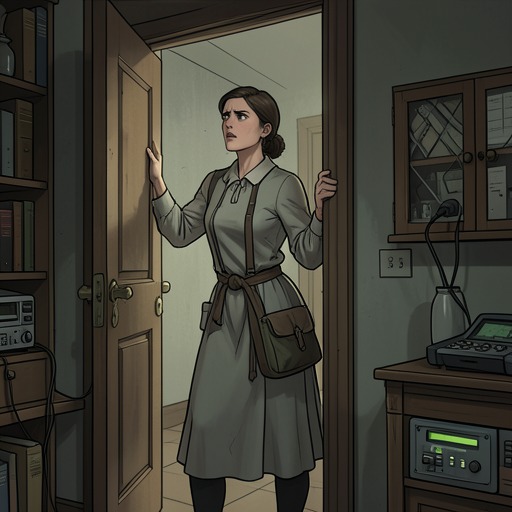
At seventeen, Billie imagines becoming a girl on the verge of womanhood as a deliberate remaking of the self. She wants to leave behind private-school uniforms and their shortened skirts, and pictures cutting her hair, choosing darker nail polish, speaking more slowly, selecting her words, laughing less loudly, and letting her eyes shine. The details make maturity feel at once physical and performed: a change in how she looks, moves, and presents herself, as well as something she hopes to feel inwardly.
That wish is bound up with loneliness and romantic expectation. Billie longs for a boy’s arms to catch her in an imagined fall, and hopes for a little magic in her evening. Becoming more womanly appears to promise attention and connection, yet she also insists that she is not ready to become a woman all at once. Her desired state is transitional by definition: not the child she fears becoming again when sad, but not yet the fully formed woman she admires in her sister Annette.
Comparison and self-consciousness
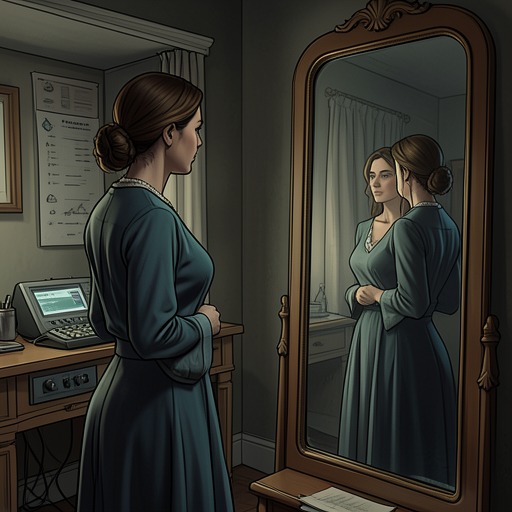
Billie measures her progress against Annette, who seems to shine effortlessly. Their sisterhood holds love and envy together, and Billie hopes that with age the jealousy will soften into love alone. She calls Annette a real woman, from her body to the inside of her head, while describing herself as shifting between a child-girl when sad and an almost-woman when she is not. Womanhood is therefore not simply a biological destination; it is also an image Billie sees embodied by someone close to her, and one she does not yet believe she has attained.
Pierre intensifies that self-measurement. After seeing him speak privately with a tall brunette, Billie feels bodily agitation, wonders whether the other woman is more beautiful, and thinks of her as nearly a woman. Her attraction to Pierre thus meets her insecurity about appearance and maturity: the possibility of his interest in another woman becomes, in Billie’s mind, a comparison between the woman she hopes to become and the one she fears she is not.
Naming desire and approaching the threshold
When Billie finally speaks to Annette about what she wants, her sister supplies the words Billie is reluctant to say: she is in love with Pierre and wants to do more than kiss him. Billie denies it, turns red, and begins searching Annette’s wardrobe for something suitable in case she decides to go. The exchange makes the transition toward womanhood inseparable from the effort to name desire—and from the embarrassment of having that desire recognized by someone else before Billie can comfortably claim it herself.
As the possibility of sex becomes immediate, Billie’s attention fixes on the body and on how she imagines it will be judged. She worries that she is sweaty and sticky, fears being ugly naked, wonders whether she is supposed to make sounds she does not like, and recoils from the thought of lying spread out in an unfamiliar bed. These anxieties complicate any simple picture of sexual initiation as confidence or arrival: the threshold is approached through uncertainty about appearance, conduct, comfort, and consent.
The first experience and its aftermath
Afterward, Billie thinks ahead to how she will tell the story and to whom. She imagines recording the change in her journal with a thick, dark-red pen, announcing that she is no longer a virgin in a deliberately childish, almost comic refrain. The imagined entry gives her a way to mark a before and an after, even as its playful wording keeps the declaration from sounding like a complete account of what has happened.
Her private assessment is more complicated. The sex was not especially pleasurable, but Pierre was gentle and wanted, in his way, to make it beautiful. Billie excuses his awkwardness and feels happy to be with him, proud of their intimacy and comforted by his body against hers; at the same time, she wants to cry. She dresses in her green robe and underwear, leaves without speaking, and walks through the chalet corridor with tears blurring her sight. Outside, under the entrance light with mosquitoes circling, she finds the mountain and the distant city more real and concrete than love as seen through Pierre’s eyes. The moment that was supposed to confirm a new identity instead exposes a gap between romantic expectation and her own bodily, unsettled experience.
A status that does not settle
Billie’s first declaration that she is a woman comes while she waits for Daphné after leaving Pierre’s chalet. The claim is private and provisional: she repeats it to herself as a way to take hold of what has happened, while the night outside offers no confirmation that she has crossed into a different life. She has chosen to leave the intimacy behind and wait in silence, needing to feel her whole body again; the assertion is an attempt to name a change before she knows what it means.
In September, Billie gives the claim another form in her diary, writing in large letters with a cinnamon-red felt-tip pen that she is a woman, that it seems cool—or perhaps not—and that it has changed nothing so far. She fills a whole page, then emphasizes the same conclusion: until now, nothing is different. The contrast between the scale of the writing and the flatness of its verdict captures the uncertainty of the transition. Losing virginity supplies a clear before and after in language, but womanhood does not arrive as an equally clear internal transformation.
That uncertainty sharpens when Pierre does not answer her invitation to share a blue raspberry slush. A week has passed since they went for burgers with her father, and Billie fears that Pierre has lost interest; she wishes he would explain, even in a letter that was partly unkind and partly tender. Her new status has not secured affection or made their connection easier to understand. The passage thus leaves the transition open-ended: Billie can record what happened and call herself a woman, while still confronting the old vulnerabilities of desire, waiting, and not knowing what the other person feels.